05 Jan 2026
Trailblazing engineman was in the driving seat for global railway revolution
Plans for a tribute to a pioneering 19th century British locomotive driver who was laid to rest in Leeds are gathering steam following a chance discovery at a local museum.
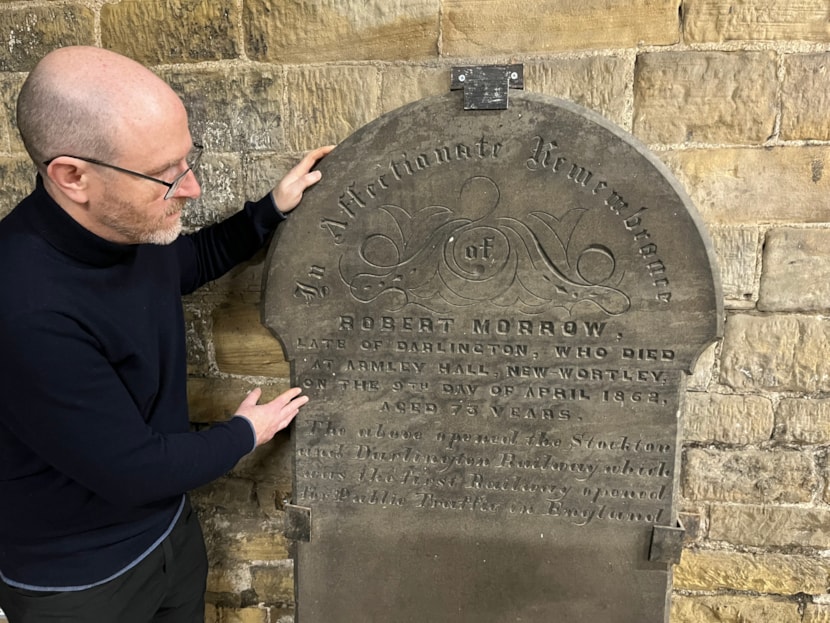
During recent renovation work at Leeds Industrial Museum in Armley, curators happened upon the beautifully carved gravestone of Robert Morrow, more than 160 years after his death in nearby New Wortley.
With little information about who he was, or how his headstone came to be at the museum, the mysterious memorial sparked a fact-finding mission which has since revealed fascinating insights into one man’s key role in what became a global railway revolution.
The somewhat cryptic inscription on Mr Morrow’s gravestone notes that he “opened the Stockton and Darlington Railway”, which records show was the first railway in the world to carry goods and passengers using steam locomotives when it opened in 1825.
The innovation’s popularity skyrocketed, quickly becoming the preeminent way of transporting both goods and people as well as a hugely lucrative venture that was soon replicated by companies across the UK and then the world.
Delving further into records and archives, curators found that Mr Morrow, affectionately known as Auld Robert, was very much at the forefront of the line’s formative years, ranking among the first drivers of its early engines and taking charge of Hope, their Locomotive Number 2.
He was joined on those experimental locomotives by fellow driver James Stephenson, brother of the line’s chief engineer and world-famous designer George Stephenson.
Life on the rails was not an easy one for drivers like Mr Morrow, who were expected to pay for staff, coal, oil and other expenses out of their own pockets.
They were also frequently at the centre of workplace accidents and managed engines beset with maintenance issues that dogged the railway’s early days.
Nevertheless, the line’s popularity swiftly grew and between 30,000 and 40,000 passengers travelled on it between July 1826 and June 1827.
For the rest of his days, Mr Morrow was known to have been extremely proud of his important role in establishing the line, a fact exemplified by both the text on his tombstone and in his death notice, which featured in The Leeds Times on April 19, 1862 and which also mentioned his former job.
He died at Armley Hall, the home of his son-in-law Thomas Ambrose and was laid to rest at New Bethel Chapel before his headstone was acquired by a former curator at the museum in 1993.
The museum team is now working on ensuring Mr Morrow’s headstone has pride of place in the locomotive gallery, which is currently undergoing a major refurbishment project.
The gallery is home to a collection of historic locomotives, including Leeds-built engines Junin and Aldwyth.
John McGoldrick, Leeds Museums and Galleries’ curator of industrial history, said: “We’ve been on a genuinely fascinating journey, discovering more about Robert Morrow’s life, legacy and links to Leeds.
“The railways have become such a huge part of the story of British industry, so much so that certain engines, lines and individuals have become household names which have echoed through the centuries.
“But lesser-known figures like Mr Morrow played their own key role in establishing the foundations of what was at the time a massive, exciting and innovative leap forward in the way people travelled.
“It seems fitting that we’re able to pay tribute to his legacy today and I’m sure ‘Auld Robert’ would feel very much at home resting among the engines at the museum.”
Once the world’s largest woollen mill, Leeds Industrial Museum is today home to a vast array of vintage machinery which is stored, conserved and displayed in galleries paying tribute to some of the city’s key industries.
Councillor Salma Arif, Leeds City Council’s executive member for adult social care, active lifestyles and culture, said: “Leeds has played a key role in so many industries which have had a lasting impact across the globe.
“It’s wonderful that, through our collection, we are able to pay tribute to those industries as well as the individuals who, through their skill, determination and drive, laid the groundwork for centuries of innovation.”
For more information about Leeds Industrial Museum including opening hours and entry fees, visit: Leeds Industrial Museum at Armley Mills | Leeds Museums and Galleries | Days out and exhibitions
ENDS
For media enquiries contact:
Leeds City Council Communications team
communicationsteam@leeds.gov.uk