16 Feb 2026
Archives to shed new light on historic charter’s Canterbury tale
One of the most important documents in the history of Leeds was rescued from being turned into a makeshift lampshade, the city’s archivists have revealed.
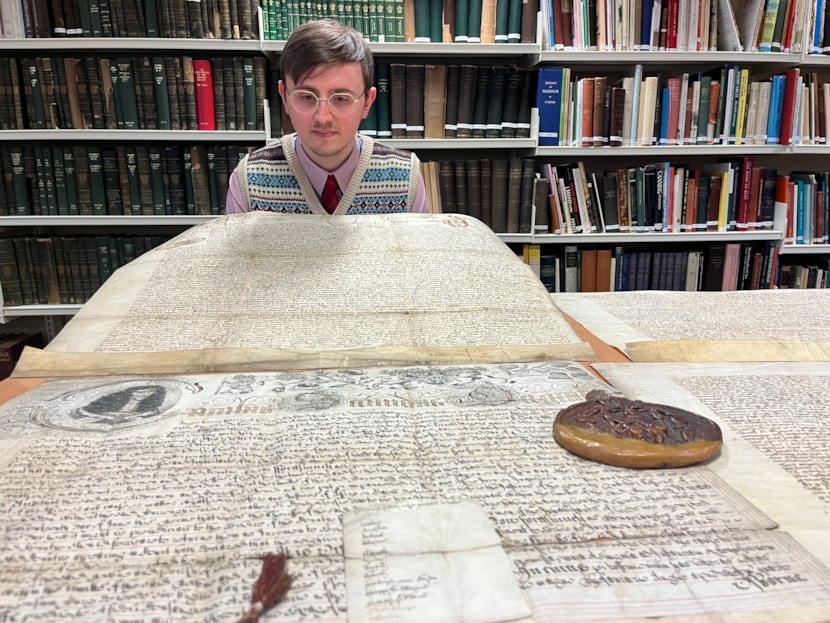
The one-of-a-kind copy of the Leeds Royal Charter, written centuries ago, was about to be repurposed as an unusual decorative feature by the unwitting owner of a Canterbury book shop in the 1950s.
Fortunately, a chance consultation with a friendly expert disclosed that the delicately inscribed text was the sole remaining copy of the Royal Charter first granted to Leeds by King Charles I in 1626.
Records show Mr C E Cheshire, the owner of the bookshop, had purchased it at a village sale in east Kent before it fell behind a bookcase at his shop, where it lay forgotten for the next six years.
Upon rediscovering it, he asked his archivist friend to take a look, intending to create a stylish new lampshade from what he initially thought was a piece of antique vellum.
But when the true significance of his extraordinary find came to light, the Corporation of Leeds quickly put plans in motion to secure the charter, offering to buy it for £10 and 10 shillings.
However, in a noble gesture, Mr Cheshire instead decided to gift the document back to the people of Leeds, writing on July 8, 1952: “As we now realise the importance of this missing link in your civic history we would like you to ask the Lord Mayor, Aldermen and Members of the Corporation if they would accept this Copy of the Charter as a gift to the Citizens of Leeds from my Son (C E Cheshire Junr) and myself.”
Today the precious parchment resides at the West Yorkshire Archive Service in Leeds, where it will soon go on display as part this year’s Leeds 400 celebrations, which will see the city come together to mark four centuries since the charter was bestowed on the city.
Beautifully inked on animal skin in Latin, the document itself dates from 1646, and is a precise copy of its 1626 counterpart that was urgently written as a replacement by 17th century scribes after the original was lost during the English Civil War.
The granting of the prestigious charter changed the course of the city’s history, laying the foundations of modern-day Leeds by incorporating it as a “free borough” and a “body corporate and politic.”
Alex Pearson, archives assistant with West Yorkshire Archive Service, said: “The charter is a truly impressive document and a physical representation of what was without a doubt one of the most significant moments in the history of Leeds.
“It’s astonishing to think the only remaining copy almost became a lampshade, and it goes to show how even the most important documents can sometimes crop up in the most unlikely places.
“Not only did having a Royal Charter give the city a considerable amount of added prestige at the time, it also laid down some of the pivotal political, economic and social rules which helped the city take control of its own destiny and begin to grow into the place we know today.
“Four hundred years later, we can still see the massive impact the charter had on Leeds and as the city celebrates this historic year, it’s a privilege to give people the chance to see such a remarkable piece of heritage in person.”
A second ornate charter, granted decades later in 1661 by Charles II, is also preserved at the archive service. That document gave the city even further autonomy, allowing among other things the appointment of a mayor as its most senior official.
The documents are among millions preserved at the West Yorkshire Archive Service and throughout the year, staff will be giving the public a chance to see some of the highlights of their collection as part of Leeds 400.
The exhibitions will be part of a programme of exciting events and activities across the city which aim to capture the spirit, creativity and culture of Leeds, with key stakeholders working together to mark the occasion.
Residents, groups and organisations are also being encouraged to get involved and celebrate in their own way.
Councillor Salma Arif, Leeds City Council’s executive member for adult social care, active lifestyles and culture, said: “Leeds 400 is a chance for us to look back at some of the landmark moments which helped shape Leeds, and it’s wonderful that we still have such a historic document as a tangible reminder of our city’s unique story.
“Throughout the year, we’re looking forward to working with partners, communities and organisations across the city to celebrate this important milestone and we hope everyone will join us in showcasing the very best of past, present and future Leeds.”
Details on West Yorkshire Archives Service can be found at: West Yorkshire Heritage | West Yorkshire Archive Service
More information on getting involved with Leeds 400, including hosting your own events, can be found at: Leeds 400 - a year of celebration | Leeds.gov.uk
ENDS
For media enquiries contact:
Leeds City Council Communications team
communicationsteam@pr.leeds.gov.uk